I asked GPT-5.5 to generate article ideas for this website. Five ideas came back. Generic, safe, interchangeable. I added more context. Same cluster. I said “be creative.” Still the same cluster, different words. The model was not being lazy. It was doing exactly what probability dictates: following the highest-probability path through its training data, more context refining the path but never redirecting it.
Then I ran the same brief through a bisociation pipeline that injects structurally distant knowledge domains into the prompt. The ideas were different. Not just different words. Different angles entirely.
That pipeline comes from Open-Collider, a project by Cédric Lion at Oparine. The numbers behind it are striking.
What the research found
Open-Collider tested four conditions across 12 real-world projects, generating roughly 23,000 ideas, judged by 4,320 blind LLM-judge verdicts. The conditions:
- A (Open-Collider): Inject structurally distant domains into the prompt.
- B (Baseline): Standard direct prompting.
- C (“Be Original”): Explicit instruction to be creative.
- D (Long Brief): Rich, detailed in-domain context, same length as A, no cross-domain content.
The falsifier tests are what make this convincing. If pure length explained the shift, D would match A. It does not: D’s effect is 2.8 to 4 times smaller. If a “be original” push worked, C would match A. It does not: C’s effect is 5.7 to 13 times smaller. A beat all other conditions on geometric distance in 12 out of 12 projects (p = 0.0002), using two different embedding models.
Distance only proves the ideas are different. The blind judges prove they are better: three models (Claude Opus 4.6, GPT-4o, Gemini 2.5) preferred condition A on originality in 10 of 12 projects (62% mean preference, p = 0.019).
The uncomfortable conclusion: telling an LLM to be creative is one of the least effective things you can do. Adding more in-domain context is the second least effective. The only thing that consistently produces outputs far from the default basin is forcing the model to reason through something it would never encounter on its own.
The theory: idea space and gravitational fields
The mental model comes from Arthur Koestler’s 1964 work on bisociation. Picture an idea space where proximity means similarity. A prompt creates a gravitational cluster. The model generates responses near that cluster, pulled by two forces:
- Local gravity from the prompt itself, concentrated by more words.
- Global gravity from the aggregate of training data, pulling everything toward the mediocre center.
Adding more in-domain context increases the local gravity, but toward your already-known ideas, not toward original ones. The response gets sharper, not more creative.
The solution is structural collision. Take two subjects far apart in idea space. Force them into the same prompt. The bet is that they share a hidden dimension, a causal structure invisible from the surface. When that dimension exists, the collision transfers mechanism across domains and produces a non-trivial insight. When it does not exist, you get a decorative analogy.
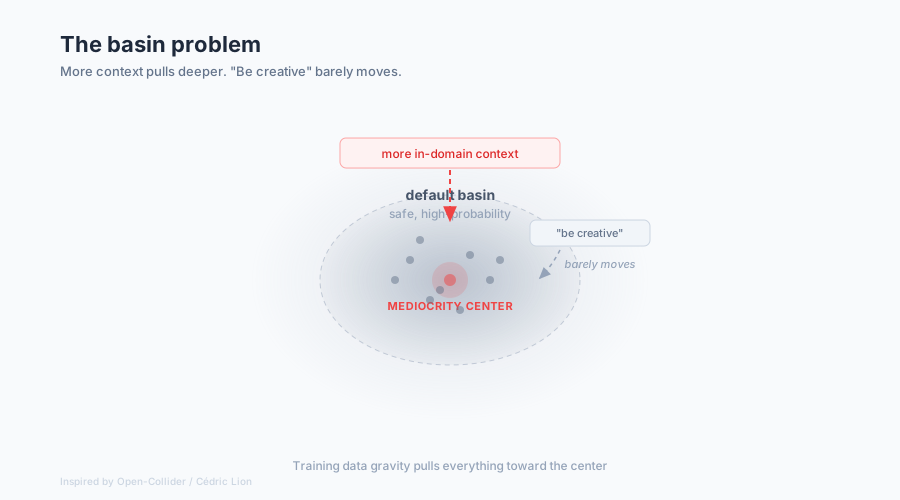
More in-domain context increases local gravity, pulling responses deeper into the same basin. Telling the model to be creative barely moves the needle.
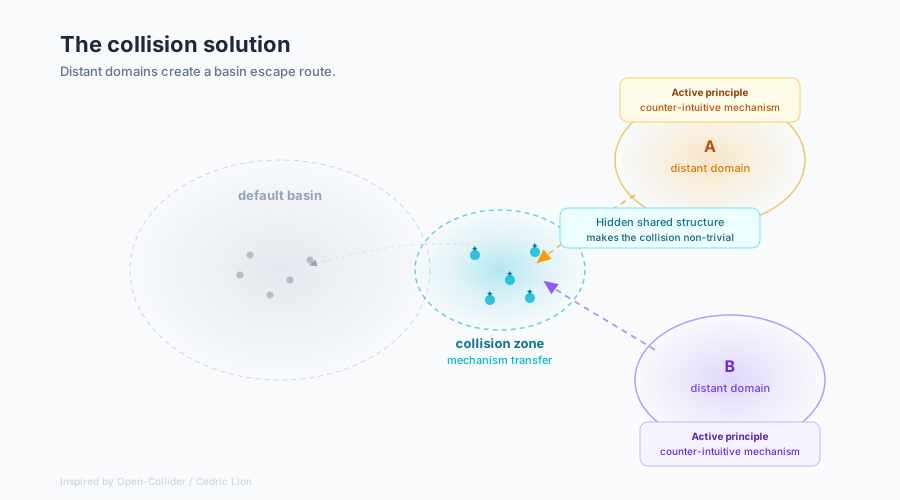
Open-Collider’s core move: inject structurally distant domains that create attractors outside the default basin. Where their fields collide, non-trivial ideas emerge through mechanism transfer.
The method needs volume because most collisions miss. It needs curation because the misses look similar to the hits. And it needs iteration because the first round of domains is usually too safe.
The Open-Collider pipeline
The project built a 4-phase loop:
Domain generation. The LLM produces sets of structurally distant knowledge domains. Not random topics. Each domain has an “active principle”: a 3-6 sentence narrative describing a counter-intuitive mechanism, ending with an open question that bridges to the project’s problem. The constraint is maximize distance from the project’s territory and diversity between sets.
Idea generation. Cross reference texts (articles, transcripts, research notes) with domain sets. Each (text, domain) combination produces roughly 20 ideas. The prompt forces the model to structurally use the domain mechanism, not just name-drop it. It also demands axiomatic inversions: ideas that flip an implicit assumption.
Scoring. A 5-axis LLM judge evaluates each idea: structural originality, resistance to objection, thesis density, concrete grounding, cognitive load. Weighted sum. Threshold at 4.2 out of 5, with an adaptive drift mechanism that lowers the threshold in 0.1 steps if too few ideas pass.
Curation. A human flags each idea as love, like, or trash. This is not decoration. The flags drive the next iteration.
After iteration 1, the pipeline evolves its domain strategy. Three modes: Fresh (random distant domains, pure exploration), Deepen (new specialties within families that produced loved ideas), and Refresh (extract causal mechanisms from best ideas, find new disciplines with the same structural patterns). Loved ideas trigger Deepen. Liked ideas trigger Refresh. Sessions typically exhaust after 3 to 5 iterations.
The source code is at CL-ML/open-collider, the conceptual foundation at the README, and the empirical validation at CL-ML/open-collider-research.
What I adapted and why
I did not want to run the Anthropic SDK orchestration. The project’s API mode is locked to Claude. The skill mode requires Claude Code subagents. I use Hermes with multiple providers, and I wanted the method to work regardless of which model is behind it.
So I ported the prompts and the strategy logic as a Hermes skill. The prompts are ported directly from Open-Collider’s templates. The domain generation prompts for fresh, deepen, and refresh strategies are essentially unchanged. The idea generation prompt is the same. The judge prompt with its 5 axes and calibration framework is the same. The intellectual content is Lion’s.
What changed is the runtime. Instead of asyncio with Anthropic SDK calls, the pipeline uses parallel agent calls. Instead of a Python orchestrator managing concurrency with semaphores and retry logic, Hermes handles the parallelism natively. Instead of YAML state files with a full Python package managing iteration state, I use JSON files that the agent reads and writes directly.
The curation guide and kill signals (decorative analogies, generic advice with domain garnish, unverifiable claims, motivational reframing) are new. They came from reading Open-Collider’s brainstorm.md command and reworking the curation step into something an agent could present to a human during an interactive session.
The result is simpler. No Python package to install. No API key requirement. The skill loads into any Hermes session. But it is also less automated. The original has async parallel idea generation with stratified sampling and concurrency control. The Hermes version delegates that to agent calls, which is more flexible but less predictable in timing.
The BGE embedding distance measurement from the research branch is not included. It validates that outputs are geometrically distant, which is useful for benchmarking but not for the production method. The judge’s originality axis handles quality. Distance is structural, not measured.
What I found interesting
The most counterintuitive claim in the research is that adding more context makes things worse. Not neutral, worse. I would have expected a richer brief to help. The data says it concentrates the response deeper into the same basin. That changes how I think about prompting for creativity.
The second thing: the curation step is where the method earns its value. The machine generates volume. The human selects signal. The kill signals matter more than the scoring. An LLM judge gives you a number. A human catches the decorative analogy, the generic advice with domain garnish, the motivational reframing. The scoring is necessary but not sufficient.
The third thing: the 3-strategy evolution (fresh/deepen/refresh) is the part I did not expect to be so well-designed. Fresh is obvious. Deepen exploits what worked. Refresh is the clever one: it extracts causal mechanisms from best ideas and finds new disciplines with the same structural patterns. That is not just exploration or exploitation. It is transfer.
What the prompts look like
The prompts are the method. Here is what matters.
Domain generation (fresh strategy). The prompt tells the LLM to generate sets of structurally distant knowledge domains in strict YAML. Each domain gets an “active_principle”: a 3-6 sentence narrative. The key instruction:
Each domain has an active_principle: a 3-6 sentence narrative describing a counter-intuitive mechanism and ending with an open question bridging to the project’s world.
The prompt excludes families used in previous iterations to prevent repetition. The deepen prompt generates new specialties within families that produced loved ideas. The refresh prompt extracts causal mechanisms and finds new disciplines with the same structural patterns.
Idea generation. The prompt crosses a reference text with a domain list. It demands:
Each idea structurally different (different angle, not just different theme). Max 2 ideas on the same theme. Max 2 ideas using the same analogy type. No hedging, no filtering.
It also asks for axiomatic inversions: “X is good” explored as “X might be the problem.” At least 5 ideas must invert an implicit assumption.
The judge. Five axes, weighted:
| Axis | Weight | Question |
|---|---|---|
| Structural originality | 0.25 | Is the underlying thesis genuinely new? |
| Resistance | 0.20 | Does it hold against the strongest objection? |
| Thesis density | 0.20 | Could it be a single testable thesis? |
| Concrete grounding | 0.20 | Could it rely on a specific fact or event? |
| Cognitive load | 0.15 | Does it force the reader to reconstruct? |
Score = weighted sum. Pass threshold: 4.2/5. If fewer than 3 ideas pass, lower in 0.1 steps down to 4.0. The judge prompt includes calibration examples: high-value and low-value reference ideas that ground the scoring.
Curation kill signals. Five patterns that get flagged automatically:
- Decorative analogy: domain adds color but no structural insight
- Generic advice with domain garnish: remove the domain reference and the idea stays the same
- Unverifiable claims: invented statistics, vague “researchers found…”
- Motivational reframing: “Your failure was actually a strength”
- Same insight different domain: keep only the stronger formulation
These are patterns that LLM judges miss but humans catch immediately.
When this is useful
This is not a general-purpose creativity tool. It works when:
- You have a specific problem that standard thinking has not cracked.
- You can articulate what a good idea looks like structurally.
- You have reference material that defines one side of the collision.
- You are willing to spend 3 to 5 iterations curating, not just generating.
It does not work when the problem is too broad, when you want a single-shot answer, or when the brief cannot be made specific enough to anchor the collisions.
Further reading
- Open-Collider - source code and pipeline
- Open-Collider research - empirical validation
- Why direct prompting pushes LLMs toward mediocrity - the conceptual foundation by Cédric Lion at Oparine